XAI Router and YAI Router: Shared Website, Independent Accounts and Core APIs
Posted June 10, 2026 by XAI Product Team ‐ 8 min read
XAI Router and YAI Router are sibling sites built on the same architecture. They share the same website content, while their account systems and core APIs run independently. For enterprises, this is not just another domain. It is a clearly bounded access path that can be planned.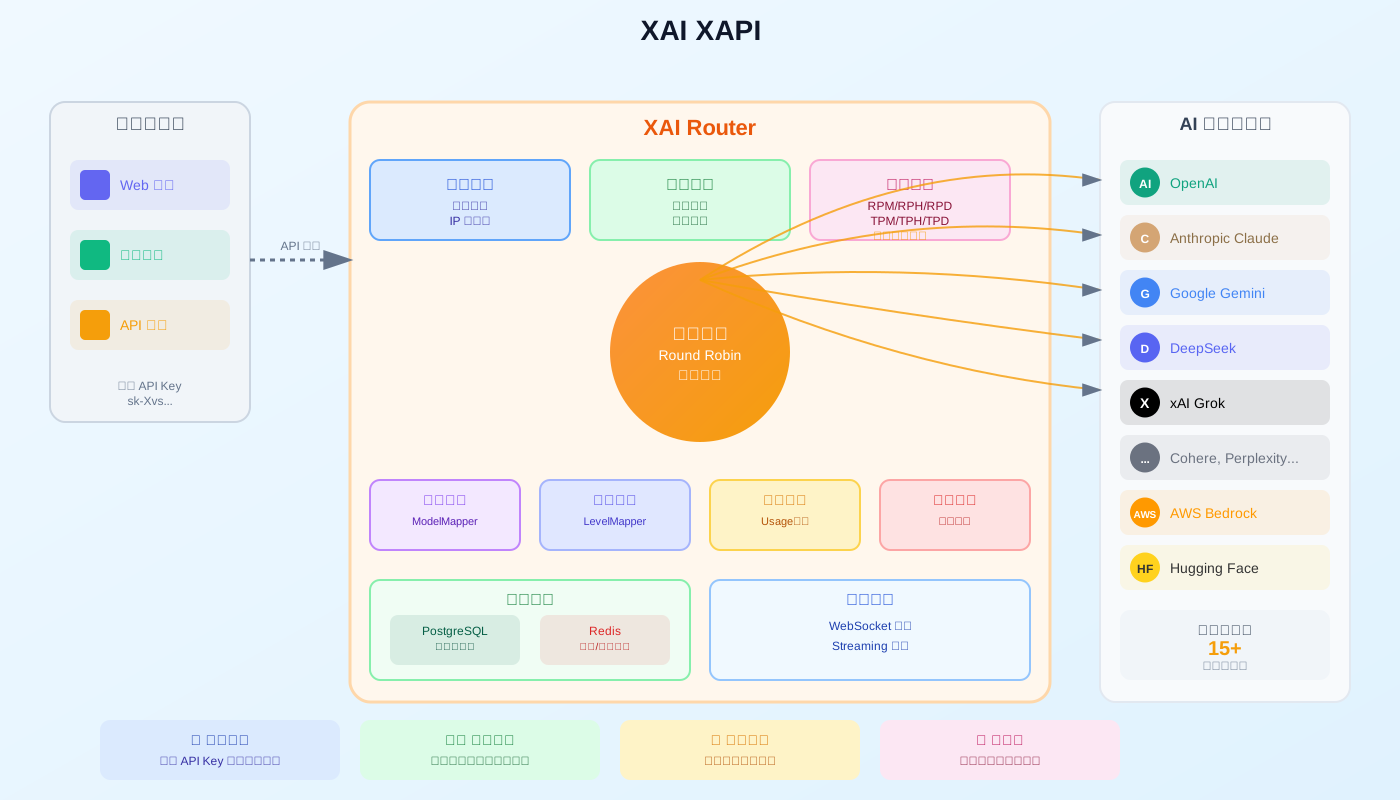
When users first see both xairouter.com and yairouter.com, a few questions naturally come up:
- What is the relationship between the two sites?
- Why does the website content look the same?
- Are accounts shared between the two sites?
- Which API should an enterprise system call?
- How should the two entrypoints be understood for high availability?
This article explains the boundary clearly.
In one sentence: XAI Router and YAI Router are sibling sites built on the same architecture. They share the same website content, while their account systems, service entrypoints, and core APIs run independently.
The Short Version
For user access and enterprise integration, think of the two sites as four separate layers:
| Layer | XAI Router | YAI Router | What it means |
|---|---|---|---|
| Website content | https://xairouter.com | https://yairouter.com | The same website, docs entrypoints, and product explanations are presented from both domains |
| Account system | XAI Router account | YAI Router account | Fully independent. Accounts, API keys, and credits are managed per site |
| Service entrypoint | https://m.xairouter.com | https://m.yairouter.com | Login, plans, console, and service operations live under separate entrypoints |
| Core API | https://api.xairouter.com | https://api.yairouter.com | The two core API entrypoints run independently and can be planned separately by enterprises |
So yairouter.com is not an unrelated product, and it is not just a copied page. It shares the same architecture and product expression with XAI Router, while keeping independent boundaries at the account-system and core-API layers.
For individual users, "two sibling sites" is usually enough to understand the relationship. For enterprises, the important part is more precise: the account systems and core APIs run independently.
Why The Website Content Is Shared
XAI Router and YAI Router serve the same category of capabilities: AI API routing, model access, AI Coding tool support, quota governance, usage analytics, and enterprise integration.
Keeping the same website content across both sites has three practical benefits:
Consistent information
Users do not need to guess which site has the latest docs or the correct product explanation.Simple positioning
XAI Router and YAI Router are sibling sites, not two unrelated or competing product lines.Clear integration boundaries
The website explains the product. The account systems, service entrypoints, and core APIs carry actual business usage.
In short, shared website content reduces user confusion. Independent account systems and APIs give enterprise integrations clearer boundaries and stronger engineering options.
What "Fully Independent Account Systems" Means
This is the most important point for enterprise users:
The account systems of XAI Router and YAI Router are fully independent.
That means:
- An account registered or used at
m.xairouter.comis an XAI Router account - An account registered or used at
m.yairouter.comis a YAI Router account - API keys created on XAI Router should be used with
api.xairouter.com - API keys created on YAI Router should be used with
api.yairouter.com - Accounts, API keys, credits, and console settings are managed separately per site
Do not assume that an account from one site can directly sign in to the other site. Do not assume that an API key from one site can directly call the other site's core API.
For enterprises, this boundary matters. It lets account ownership, credits, permissions, and audit trails be planned separately for each entrypoint. It also prevents a hidden failure mode during primary/backup or dual-endpoint setups: switching the API endpoint but leaving the API key from the other site in place.
If an enterprise wants unified procurement, credits, billing, or policy arrangements across both sites, that should be confirmed during enterprise cooperation instead of assuming default account interoperability.
Why The Core APIs Are Independent
Once an enterprise connects AI APIs to internal systems, the question is no longer just "can this call succeed today?" Longer-term operational questions appear quickly:
- Do engineering teams, automation jobs, and internal systems have a stable entrypoint?
- If one entrypoint is affected by network, routing, rate-limit, or maintenance issues, is there another path?
- Can the API Base URL be changed from configuration instead of being hardcoded in application code?
- Can logs, alerts, health checks, and failover drills distinguish between different entrypoints?
This is the value of independent core APIs.
https://api.xairouter.com and https://api.yairouter.com exist as two independent API entrypoints. Enterprises can use them to design primary/backup access, dual-endpoint access, or business continuity plans at the client, internal gateway, service discovery, or configuration-center layer.
One point needs to be explicit: the two account systems are fully independent, and independent APIs do not mean accounts, billing, or credits automatically interoperate. Account ownership, credit allocation, billing structure, and enterprise policies should follow the actual backend configuration and enterprise agreement.
That is the safer enterprise interpretation: independent API entrypoints are infrastructure capability. Whether to use primary/backup, how to switch, and which business workloads use which entrypoint are integration decisions that enterprises can design according to their own requirements.
How Enterprises Should Integrate
The most important recommendation is simple: do not hardcode the Base URL in business code.
At minimum, keep API entrypoints in environment variables or a configuration center:
XAI_ROUTER_BASE_URL=https://api.xairouter.com/v1
XAI_ROUTER_API_KEY=sk-xai-...

YAI_ROUTER_BASE_URL=https://api.yairouter.com/v1
YAI_ROUTER_API_KEY=sk-yai-...
Application code can keep the normal OpenAI-compatible SDK pattern. The baseURL and the matching API key should both come from configuration:
import OpenAI from "openai";

const client = new OpenAI({
  apiKey: process.env.AI_API_KEY,
  baseURL: process.env.AI_BASE_URL || "https://api.xairouter.com/v1",
});

const response = await client.chat.completions.create({
  model: "gpt-5-nano",
  messages: [{ role: "user", content: "hello" }],
});
If the enterprise wants a primary/backup setup, the current primary entrypoint can be kept in configuration:
AI_BASE_URL=https://api.xairouter.com/v1
AI_API_KEY=sk-xai-...
When switching, update both the Base URL and the API key to the matching site:
AI_BASE_URL=https://api.yairouter.com/v1
AI_API_KEY=sk-yai-...
More mature teams can implement health checks and switching logic in an internal API gateway, service discovery layer, or shared business SDK. The switching logic should not be scattered across every business function.
Enterprise Integration Checklist
If you are an enterprise administrator, platform engineering owner, or engineering lead, use this checklist:
Make the Base URL configurable
All applications should read the API Base URL from environment variables, a configuration center, or an internal gateway.Keep API keys paired with their sites
The XAI Router API key should be paired withapi.xairouter.com; the YAI Router API key should be paired withapi.yairouter.com.Add both API domains to network allowlists
Enterprise egress rules, firewalls, proxies, zero-trust gateways, and log systems should include bothapi.xairouter.comandapi.yairouter.com.Separate observability labels
Logs and monitoring should preserve anxai,yai, or endpoint label so latency, error rate, and request volume can be traced to the correct entrypoint.Define a switching procedure
Decide when to switch, who approves it, how to verify it, and whether or when to switch back.Run small failover drills
Do not wait until an incident to use the backup entrypoint for the first time. Validate it periodically with test jobs or low-risk workloads.Confirm account and credit boundaries
The two account systems are fully independent. If the enterprise needs unified procurement, credits, billing, policies, or permissions across both entrypoints, confirm the configuration with the service team in advance.
The goal is not to make integration complicated. The goal is to prevent a future high-availability plan from depending on hardcoded values hidden in application code.
FAQ
1. Do xairouter.com and yairouter.com show the same website content?
Yes. Both sites present the same website content and product explanations, so users can understand XAI Router services from either domain.
2. What are the two service entrypoints?
XAI Router service entrypoint:
https://m.xairouter.comYAI Router service entrypoint:
https://m.yairouter.com3. Are accounts shared between the two sites?
No. XAI Router and YAI Router have fully independent account systems. Accounts, API keys, credits, and console settings are managed separately per site.
4. What are the two core APIs?
XAI Router core API:
https://api.xairouter.comYAI Router core API:
https://api.yairouter.comFor OpenAI-compatible SDKs, they are typically configured as:
https://api.xairouter.com/v1
https://api.yairouter.com/v1
5. Do I need to change SDKs to use YAI Router?
Usually no. For OpenAI-compatible calls, the key changes are the baseURL and the API key for the matching site. If your code already configures both values externally, switching between the two entrypoints is much easier.
6. Do the two APIs automatically fail over to each other?
Do not assume that by default. The two core APIs run independently. Enterprises can design primary/backup access, dual-endpoint access, or continuity plans in their own clients, internal gateways, or configuration centers. Whether automatic switching is enabled, and how it works, depends on the enterprise integration design and service configuration.
7. Is this the same as private deployment?
No. The dual-site API setup provides independent cloud entrypoints. Private deployment means deploying XAI Router into the enterprise's own environment or a dedicated environment. The two approaches serve different stages of availability, control, and compliance requirements.
Summary
The relationship between XAI Router and YAI Router can be summarized as:
- Shared architecture: the two are sibling sites with consistent product capabilities and website presentation.
- Independent accounts: the account systems are fully independent; accounts, API keys, and credits are managed per site.
- Clear entrypoints: service entrypoints are
m.xairouter.comandm.yairouter.com. - Independent APIs: core APIs are
api.xairouter.comandapi.yairouter.com. - Enterprise availability planning: enterprises can design primary/backup access, dual-endpoint access, and business continuity plans as needed.
For individual users, choosing one clear entrypoint is enough. For enterprise users, Base URL configuration, API key pairing, network allowlists, observability labels, and switching procedures should be designed from day one, so the AI API becomes governed, testable, and sustainable infrastructure.
Related entrypoints: