XAI Router -> Codex-Cloud: Minimal Claude Code Compatibility Guide
Posted March 4, 2026 by XAI Technical Team ‐ 2 min read
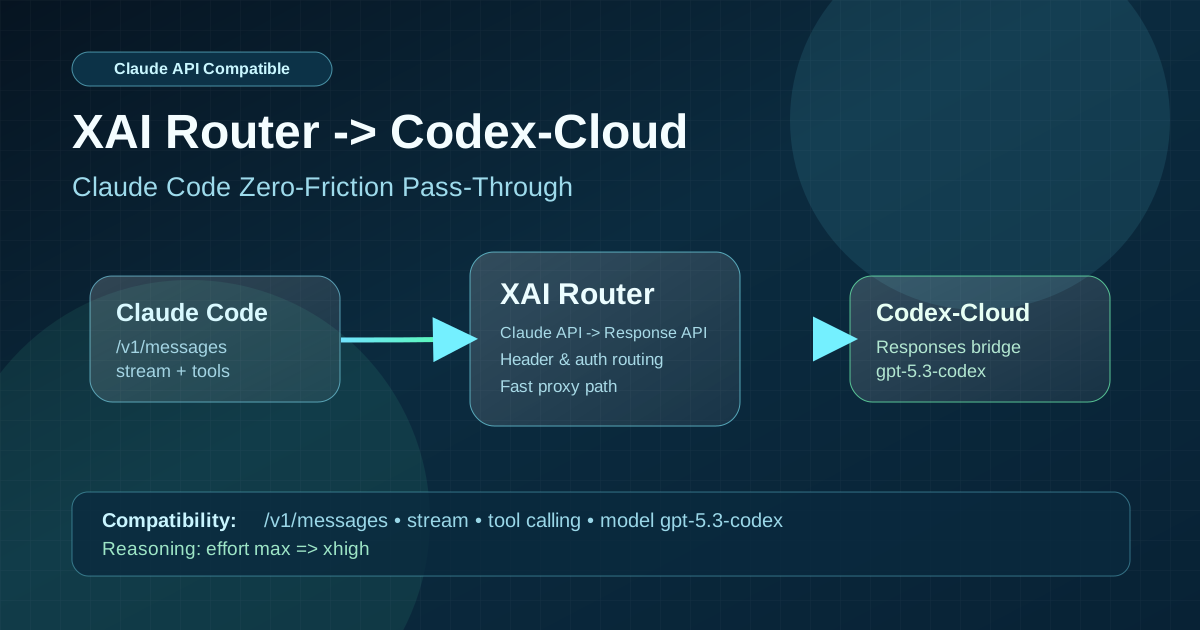
If you want a stable, simple, and controllable path to run Claude Code with gpt-5.3-codex, this is the recommended architecture:
Claude Code -> XAI Router -> Codex-Cloud -> OpenAI Response API (gpt-5.3-codex)
Its core principle is straightforward: minimum changes.
Architecture At A Glance
Claude Code
  └─ ANTHROPIC_BASE_URL=https://api.xairouter.com
     └─ /v1/messages
        └─ Codex-Cloud (Claude API -> Response API)
           └─ model: gpt-5.3-codex
Think of Codex-Cloud as a focused conversion layer:
- It receives Claude API requests.
- It applies lightweight parameter mapping.
- It forwards traffic to Response API with minimal extra logic.
Compatibility Experience (User View)
This setup is designed to feel like “Claude Code as-is”:
- Keep the same Claude Code workflow and Anthropic-style configuration.
POST /v1/messagesworks end-to-end, including streaming and tool calls.- The model is unified to
gpt-5.3-codexwithout business code rewrites. effort: "max"maps toxhighfor the highest reasoning tier.
Enterprise Scenario: Smooth Fallback When Claude API Is Unstable
For enterprise systems, one key value is this: failover stays at the gateway layer, not in application code.
When upstream quality degrades, applications can continue sending Claude API-shaped requests while XAI Router applies backend fallback strategy (for example, switching from a primary route to a Codex-Cloud backup route), which means:
- No application code changes and no protocol changes.
- The request entrypoint remains the same (
ANTHROPIC_BASE_URL). - Faster switchover and simpler rollback.
One-line summary: stable frontend behavior, switchable backend routing.
Minimal Local Config (Ready To Reuse)
Below is a reusable local config template.
1) Shell environment variables
export ANTHROPIC_BASE_URL="https://api.xairouter.com"
export ANTHROPIC_AUTH_TOKEN="sk-***"
export ANTHROPIC_DEFAULT_OPUS_MODEL="gpt-5.3-codex"
export ANTHROPIC_DEFAULT_SONNET_MODEL="gpt-5.3-codex"
export ANTHROPIC_DEFAULT_HAIKU_MODEL="gpt-5.3-codex"
2) ~/.claude/settings.json
{
  "model": "gpt-5.3-codex",
  "skipDangerousModePermissionPrompt": true,
  "effort": "max",
  "permissionMode": "bypassPermissions"
}
What this gives you:
- Default model is
gpt-5.3-codex. - Highest reasoning tier (
xhigh) viaeffort: "max". - A more direct local permission mode with fewer interruptions.
30-Second Smoke Test
1) Run Claude Code directly
claude "Write a minimal HTTP server in Rust and explain each module briefly."If responses are stable and tool calls work, the full path is ready.
FAQ
Q1: Can I still use the highest reasoning mode through this conversion path?
Yes. Set "effort": "max" in ~/.claude/settings.json, and it maps to xhigh.
One-line takeaway: XAI Router + Codex-Cloud keeps Claude API compatibility while enabling fast onboarding and enterprise-grade smooth fallback.