XAI Independent Site Program: Not Reselling, but Independently Operated AI Service Sites
Posted April 19, 2026 by XAI Product Team ‐ 12 min read
xairouter.com can be understood as XAI's official site. The independent-site model is the next step: independently operated sites built on the same system and supply base, competing fairly while delivering high-quality, well-priced AI services to developers and enterprises worldwide.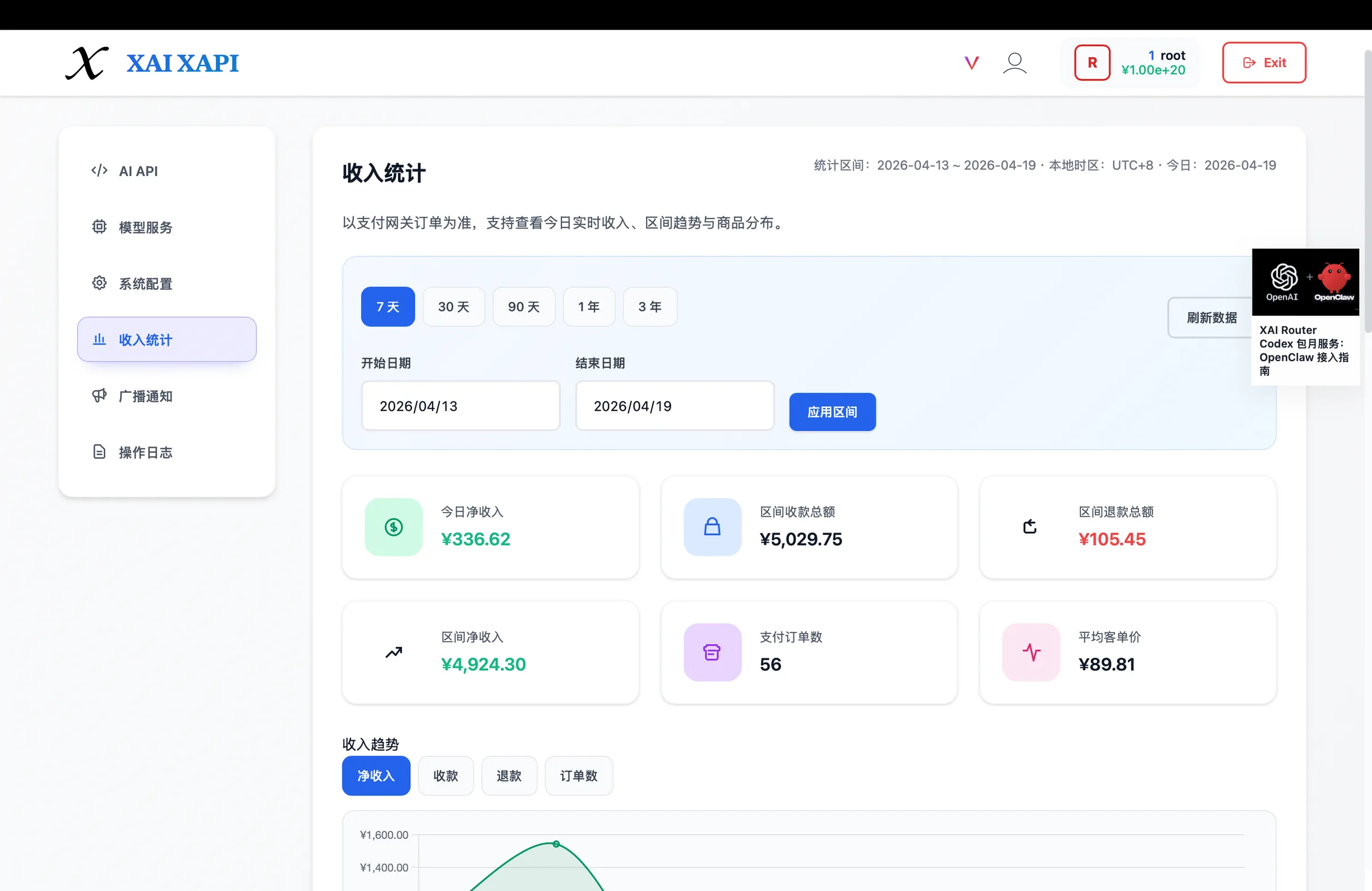
xairouter.com is, in practical terms, XAI's official site today. But if everything stays concentrated in one central site, then traffic, content, customer relationships, and operating rhythm all remain concentrated in one place as well. For a platform serving global developers, teams, and enterprises, that is not the best long-term shape.
The model we want to push next is the XAI Independent Site Program.
This is not a simple reseller scheme. It is not referral marketing. It is not a structure where all traffic ultimately gets redirected back to the official site. It is a network of independently operated AI service sites built on top of XAI Router: each site can have its own content, its own users, and its own operating style; XAI is responsible for system stability, upstream supply, and the standardized technical foundation; the independent-site operator is responsible for traffic, conversion, and day-to-day operations.
• `RMB 3,000` independent-site cooperation fee
• XAI provides the required server resources and covers hosting costs
• Package pricing is unified globally; supply cost is unified globally; the official site and independent sites compete fairly
• The operator is responsible for traffic and operations; XAI is responsible for system stability and supply; site profit is split `50/50`
• The entry threshold is intentionally low, but XAI retains admission discretion and plans to keep the network to roughly `100` sites
Why We Want Independent Sites Instead of Only an Official Site
A single official site is obviously simpler, but it also has natural limits:
- Traffic becomes too concentrated
- Local markets, technical communities, and vertical industries are not always best served by one central voice
- If operators are only agents, their incentive to build durable content and service quality is usually weak
- AI services are not one-time transactions; they are ongoing operations, ongoing support, and ongoing user education
So the model we prefer is a distributed network of independent sites.
The official site still exists, but it is no longer the only entry point. Independent sites are not subordinate landing pages under the official site. They are independent sites sharing the same technical base and supply system.
The core idea is not "sell more accounts." The real goal is to let people who actually understand users, communities, and industries go deeper and build better AI services in their own markets.
An Independent Site Is Not Selling Accounts. It Is Selling an AI Productivity Entry Point.
If XAI could only sell a single account, this model would not be very meaningful. What an independent site should really carry is a complete set of capabilities that can be continuously distributed and continuously governed:
- For developers: integrations for
Codex CLI / App,Claude Code,Gemini CLI, and similar tools - For teams: one AI API entry point, model permission control, quota distribution, and day-to-day usage analytics
- For enterprises: primary/sub-account structures, member-level resource distribution, usage audit, and cost attribution
- For more complex scenarios: unified access across domestic and international model providers, with engineering tools and business systems governed through the same entry point
That is why the independent-site model is built on top of XAI Router's existing capability stack, not on a lightweight affiliate dashboard.
From the current docs and product surface, XAI already has several critical building blocks:
- Codex / Claude / Gemini support alongside OpenAI- and Anthropic-compatible APIs This means the platform can serve both AI Coding tools and business API traffic.
- Primary/sub-account hierarchy and policy inheritance as native system capabilities That means independent sites can serve not only individual developers, but also teams and enterprise internal distribution.
- Unified governance across domestic and international model resources Beyond Codex and Claude, the same control plane can also absorb providers such as Volcengine Ark, Alibaba Cloud, Baidu Qianfan, Tencent Cloud, MiniMax, Zhipu, and Kimi Coding Plan.
- Independent deployment with a low starting threshold The existing XAI Router Self-Hosted docs already use
2C2Gas the recommended starting point; under the independent-site model, XAI provides the required server resources and covers hosting costs, making "independent site + lightweight startup" realistic both technically and operationally.
In other words, an independent site is not selling someone else's subscription. It is operating an AI resource site that can serve developers externally, serve teams internally, and grow upward into enterprise use cases.
Official Site, Independent Site, and Private Enterprise Deployment Solve Different Problems
These three modes should be separated clearly.
1. Official Site: the standardized direct-sales entry point
The official site is suitable for:
- Individual developers who want direct access
- Teams that want to trial the service quickly
- New capabilities that should be validated first in the official channel
Its value is that it acts as the standard showcase and direct official entry point.
2. Independent Site: the operator-led business model
Independent sites are suitable for:
- Operators with community traffic, content capabilities, or local customer resources
- People who want to build their own AI service brand and independent site
- Operators who want to run a long-term business under unified supply and unified pricing
The value here is straightforward: XAI's infrastructure is handed to people who actually want to operate, support, and grow real customer relationships.
3. Private Enterprise Deployment: the delivery model for customers who need control
Private enterprise deployment is suitable for:
- Enterprises with strict requirements on deployment location and data sovereignty
- Teams that want AI resource governance fully inside their own systems
- Customers that have moved from "buying tools" to "building infrastructure"
That path corresponds directly to the current XAI Router Self-Hosted offering and the Enterprise AI Coding Service delivery model. It also connects naturally with the independent-site model: an independent site can start by serving individuals and small teams, then gradually take on enterprise customers; when those customers need stronger control boundaries, the path moves naturally toward private deployment.
What XAI Owns, and What the Independent-Site Operator Owns
This model only works if the operating boundary is clear.
XAI is responsible for:
- System stability, gateway capability, and core product iteration
- Upstream resource supply and the supply framework
- The initial dedicated
Codex Proaccount used to help bootstrap a new site - Continued integration and unified governance across domestic and international model resources
- Globally unified supply cost and globally unified package pricing
- The official documentation, integration layer, account structure, analytics, and governance foundation
- During the cooperation term, enterprise customers sourced by an independent site are handled and delivered by XAI
The independent-site operator is responsible for:
- Day-to-day site operations
- Content, community reach, and traffic acquisition
- User conversion, renewals, and frontline service
- Localized messaging, vertical-market positioning, and long-term customer relationships
In one sentence: the operator is responsible for traffic; XAI is responsible for system stability and supply.
That means the site is not passively waiting for traffic from XAI. It is a genuinely independent business. At the same time, the operator does not need to assemble upstream model supply from scratch. The site operates on top of XAI's existing supply and technical foundation.
How Revenue Sharing and Settlement Work
If the relationship is only "buy inventory and resell it," the model will not stay healthy for long. Revenue sharing, payment routing, and reconciliation rules need to be explicit from the beginning.
The current proposal is:
- Under unified package pricing and unified supply, supply costs are jointly borne by the operator and XAI
- Site profit is split
50/50 - The operator is responsible for bringing in traffic and users; XAI is responsible for stable delivery, supply, and the technical foundation
- For enterprise customers sourced by an independent site during the cooperation term, XAI handles service interfacing and delivery; the independent site collects payment and allocates XAI's share according to the agreed revenue-share ratio
To accommodate different legal and payment setups, there are two settlement paths.
1. Operators who already have a WeCom Pay merchant account
If the operator already has an activated WeCom Pay merchant account, the payment gateway can be connected directly to that merchant account.
In that path:
- End users pay through the operator's merchant account
- The system records site revenue, orders, and billing details on a daily basis
- At the beginning of each month, the previous month's revenue and profit split are settled
- Based on the monthly statement, the operator transfers XAI's share to XAI through a company-to-company payment
- XAI issues the corresponding invoice to the operator
This path is better for operators that already run as independent business entities and want a cleaner merchant-side collection flow.
2. Operators who do not yet have a WeCom Pay merchant account
If the operator does not yet have a WeCom Pay merchant account, the payment gateway can first be connected to XAI's WeCom Pay account.
In that path:
- End users pay through XAI's payment gateway
- The system still records the site's revenue, orders, and split logic on a daily basis
- At the beginning of each month, the previous month's revenue is settled
- XAI pays the operator's share to the operator as operator income
This lowers the startup barrier and allows a new site to operate before it has completed its own full payment setup.
3. Daily visibility and fully traceable billing history
Regardless of which payment path is used, accounting transparency is not optional.
The target operating standard is:
- Daily site revenue can be checked
- Historical billing records remain traceable
- Every monthly split is backed by a clear statement
- Both the operator and XAI reconcile against the same accounting view
Only then does a 50/50 split become more than a slogan. It becomes a fair, verifiable, and durable revenue-sharing mechanism.
Why Unified Supply Cost and Unified Global Pricing Matter
This principle is more important than the phrase "independent site" itself.
We do not want the system to evolve into:
- Regional price arbitrage
- Information asymmetry as the main source of profit
- Disorderly packages and opaque rules creating internal price wars
We want it to become a competition over:
- Service quality
- Operating capability
- Content and community strength
- Who understands a specific industry or user segment better
That is why, whether it is the official site or an independent site, unified supply cost, unified package pricing, and fair competition are non-negotiable.
Only under that rule can the network become a real ecosystem of independent sites instead of a multi-layer markup channel.
Who Is a Good Fit to Run an XAI Independent Site
The best fit is usually someone who already has one or more of the following:
- An existing developer community, technical content channel, or vertical-industry customer base
- A genuine willingness to run an independent site over the long term rather than flip accounts for short-term gains
- Basic technical understanding of AI Coding tools and model services
- The ability to communicate value beyond "cheap," including stability, governance, analytics, and enterprise distribution capability
From that perspective, an independent site is closer to a lightweight AI-service business than to a passive license.
A Low Barrier Does Not Mean Open Admission
We want the startup barrier to stay low enough that capable operators can enter. But a low barrier does not mean unlimited admission.
More precisely:
- The
RMB 3,000independent-site cooperation fee, with XAI providing the required server resources and covering hosting costs, keeps the startup threshold deliberately low - But XAI retains its own admission judgment; this is not a "whoever applies gets in" model
- The current plan is to keep the total number of independent sites to roughly
100 - In real operations, XAI will naturally invest more enablement effort into sites with stronger customer pipelines, steadier operations, and better enterprise opportunities
That is not about manufacturing scarcity. It is about preventing the network from turning into a loose channel system with weak service quality and weak operational discipline.
This Is Also a Natural Extension of XAI's Existing Capability Boundary
The independent-site model is not a disconnected new story. It is a natural extension of what XAI Router already supports today:
- For individual developers, we already have integration paths for Codex CLI / App, Claude Code, and Gemini CLI
- For teams and enterprises, we already have primary/sub-account structures, quota governance, usage analytics, and one unified AI API entry point
- For heavier customers, we already have the Enterprise AI Coding Service path and the private deployment path
So the independent-site program is not starting over. It is a way of reorganizing the same capability base into a more distributed and more repeatable business structure.
Closing
xairouter.com will remain XAI's official site.
But if the real goal is to get high-quality, well-priced AI services into the hands of developers and enterprises worldwide, then one official site is not enough.
What we want to see is:
- The official site continuing to act as the standard reference point
- More independent sites serving different communities and markets
- XAI owning stability, supply, and the technical foundation
- Operators owning operations, users, and growth
- Everyone competing fairly under the same pricing and cost rules
That path may be slower than building one centralized platform, but it is also more durable and better suited for long-term development.