Comparing Mainstream AI API Gateways: How Does XAI Router Stand Out?
Posted July 8, 2025 ‐ 12 min read
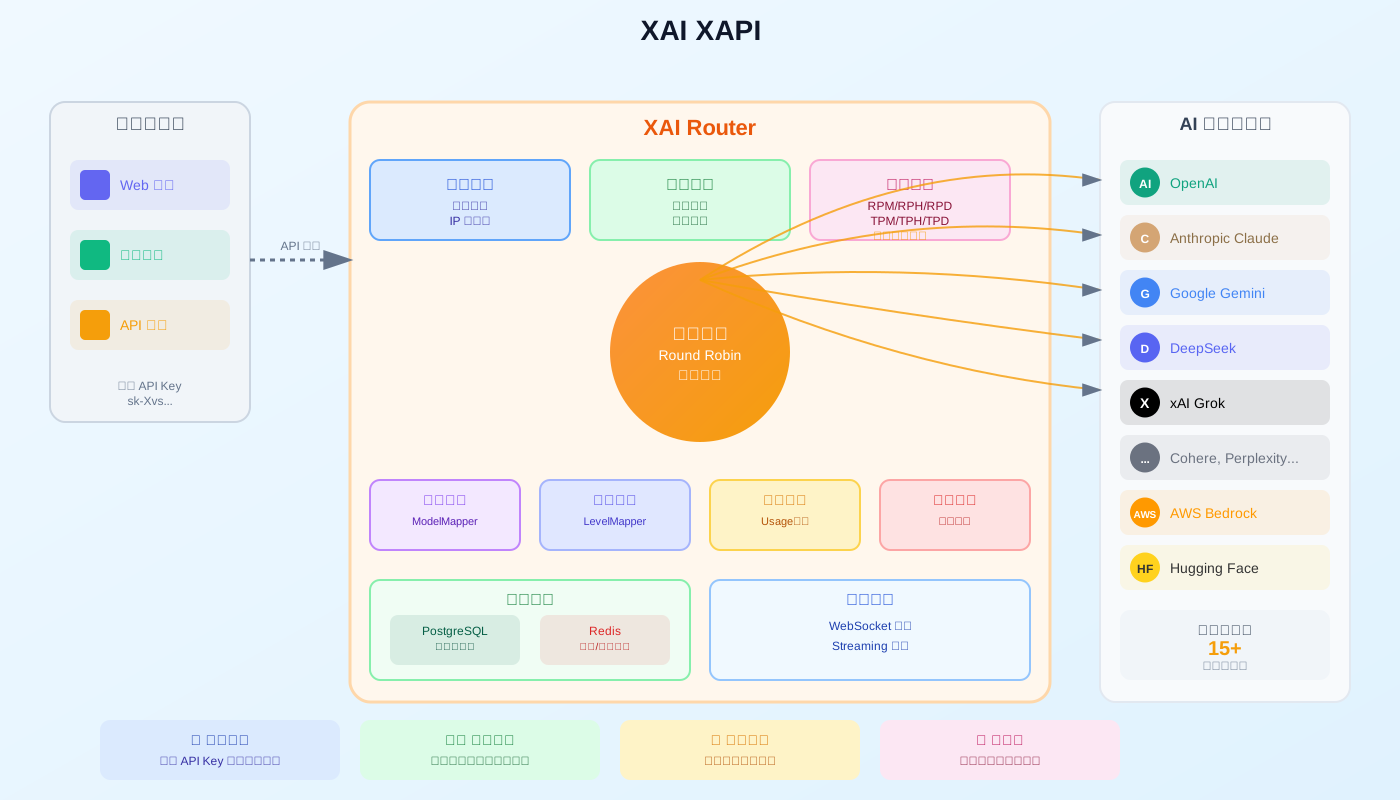
Once AI moves from prototype into production, the real problem is no longer “Can I send a request to a model?” It becomes: how do you build a system that can sustain performance, availability, cost control, permissions, analytics, and organizational governance at the same time?
That is why AI routers are evolving from simple forwarding layers into core AI infrastructure. Most mainstream options fall into four broad categories:
- Lightweight aggregators: such as One-API/New-API, optimized for fast setup and unified key access
- General-purpose gateways with AI extensions: such as Envoy, Higress, Kong, and Apisix
- Hosted routing platforms: such as OpenRouter, optimized for convenience and model variety
- AI-business-native platforms: where XAI Router sits, combining routing, governance, billing, analytics, and multi-tenant operations
If all you care about is forwarding requests, many tools can do that well. But if you care about:
- high throughput under real production load
- sub-accounts for teams, customers, or departments
- daily quotas, RPD, TPD, and budget boundaries
- cost analysis by sub-account and by model
- a management console usable by engineering, operations, and finance
then XAI Router starts to stand apart very quickly.
XAI Router's Core Design Philosophy: Not Just a Router, but an AI Business Operations Platform
Traditional API gateways are built first and foremost for traffic governance. They are excellent at authentication, routing, rate limiting, circuit breaking, observability, and plugin-based extension.
But AI businesses need a different layer of questions answered:
- Can one department have its own AI budget?
- Can one project team have its own sub-account, its own model allowlist, and its own quota?
- How much of today’s daily allowance has been used already?
- Which model is the biggest cost center?
- Which sub-account suddenly became anomalous?
- Can OpenAI, Claude, Gemini, Codex, and Claude Code all be governed under one framework?
XAI Router was designed with those questions as first-class requirements. That makes it more than a proxy. It is an AI business operations platform built around account systems, resource allocation, billing, analytics, intelligent routing, and high availability.
The Fast Conclusion: XAI Router Wins on Three Decisive Axes
What makes XAI Router distinctive is not merely broad model support. It is the fact that three strengths come together in one system.
1. Performance Is a Core Product Value, Not a Side Effect
XAI Router’s performance story is not based on removing business logic. It is based on preserving multi-tenancy, billing, analytics, and routing intelligence while still delivering high throughput.
- Rust async runtime: the core gateway is built on Rust for low tail latency, high throughput, and efficient memory usage
- Strong small-footprint performance: XAI’s public product positioning states that a single 2-core, 2GB instance can stably handle around 12,000 requests per second
- Layered hot-path caching: frequent state is served from memory first, Redis second, and the database last
- Stateless horizontal expansion: shared state is externalized so nodes can scale out cleanly
- Multi-account load balancing: since real bottlenecks often live in upstream provider limits, XAI Router pushes the ceiling outward through multi-account scheduling
For enterprises, that means XAI Router is not a feature-heavy system that collapses under load. It is meant to handle developers, support agents, operations teams, and automated workloads concurrently.
2. Analytics Are Not Just Logs; They Are the Management Surface
Many AI gateways provide monitoring, request logs, and basic observability. Enterprises usually need something more operational than that.
XAI Router’s difference is that analytics are part of the management product itself:
- Today’s quota status: visual tracking of RPD, TPD, daily allowance, and add-on card usage
- Global billing insights: total cost, total requests, total tokens, prompt tokens, completion tokens, cached tokens, image usage, search traffic, and more
- Model cost distribution: quickly identify the biggest spend drivers
- Model call distribution: distinguish “most used” from “most expensive”
- Daily trend analytics: inspect trends across cost, requests, search, token usage, and image volume
- Sub-account consumption overview: compare requests, costs, dominant models, and usage shares across sub-accounts
- Daily billing breakdowns: trace cost, model share, and cache activity by day
That matters because real AI governance is not about prettier charts. It is about giving finance, IT, and management one operating view of the same system.
3. Sub-Accounts and Resource Allocation Are Core Mechanics, Not Add-Ons
This is where many “AI router” products become much thinner than they first appear.
XAI Router’s parent-account and sub-account model is not there just to mint more keys. It exists to distribute AI as an internal operating resource:
- create, query, update, and delete sub-accounts
- top up or debit sub-accounts
- allocate AI capability across organizational layers
- apply model allowlists, daily quotas, RPD, TPD, and budget boundaries
- centrally monitor all sub-account behavior
- support DNA-style account inheritance for enterprise, channel, SaaS, and reseller structures
For hobby projects this may feel advanced. For enterprise operations, SaaS distribution, or internal AI enablement, it is table stakes.
Head-to-Head: XAI Router vs. Mainstream Options
1. vs. One-API/New-API: From Unified Access to Unified Operations
One-API/New-API represents an excellent lightweight open-source aggregator path. It is easy to deploy, supports many models, and is still one of the best fast-start options for developers.
Where One-API/New-API is strong:
- fast deployment and low setup overhead
- multi-channel aggregation with basic load balancing
- foundational quota, token, grouping, and model access controls
Where XAI Router pulls ahead:
- Stronger organizational model: One-API/New-API is closer to a flat model of users, tokens, and groups. XAI Router builds parent accounts, sub-accounts, hierarchical inheritance, and resource governance into the center of the system.
- More complete budget mechanics: XAI Router goes beyond a total balance. It supports daily quotas, RPD, TPD, pay-as-you-go cards, add-ons, subscriptions, validity windows, and richer allocation boundaries.
- Stronger analytics surface: instead of basic balance detail only, XAI Router emphasizes model distribution, sub-account distribution, cost trends, cached tokens, and image or search usage.
- More production-oriented failover: key rotation, retry, key sleeping, cross-level switching, and adaptive routing are designed with sustained operations in mind.
- Better suited to platform operators: if you are distributing AI capacity to a team, a customer base, or a reseller network, XAI Router fits that shape more naturally.
Summary: One-API/New-API is an excellent unified access layer. XAI Router is a more complete AI operating platform.
2. vs. Envoy / Higress / Kong / Apisix: Powerful Gateways, but Not Built for AI Operations
Envoy, Higress, Kong, and Apisix are all powerful general-purpose API gateways. Their maturity in traffic control, security policy, extensibility, and platform integration is undeniable.
Where these gateways are strong:
- mature traffic governance
- strong security and plugin mechanisms
- deep validation in large-scale API and microservice environments
Where XAI Router pulls ahead:
- AI business semantics are native: general-purpose gateways can recognize AI traffic, but they are still built around HTTP routing. XAI Router is built around models, tokens, quotas, AI billing, and business-level usage semantics from the start.
- Built-in business control plane: with general gateways, teams often still need to build their own account system, budgeting layer, analytics console, and tenant operations workflows. XAI Router ships those concerns as product capabilities.
- Sub-account allocation is ready out of the box: many gateway-based AI stacks are strong on the data plane and weak on the control plane. XAI Router closes that gap directly.
- Analytics are business-oriented, not just infrastructure-oriented: technical observability and operational analytics are not the same thing. XAI Router is explicitly designed to support the latter.
- Lower friction for multi-model AI operations: when you need to manage upstream keys, customer plans, employee quotas, allowlists, and cost reporting together, XAI Router is much more direct.
Summary: if your goal is to extend an existing enterprise gateway estate with AI support, general gateways are a rational choice. If your goal is to get a full AI operations platform quickly, XAI Router is the straighter path.
3. vs. OpenRouter.ai: Hosted Convenience vs. Governable, Self-Controlled AI Infrastructure
OpenRouter.ai is a highly successful hosted AI routing platform. It offers rich model coverage, quick onboarding, and a smooth experience for developers.
Where OpenRouter is strong:
- zero deployment and zero infrastructure burden
- broad model catalog and fast switching
- an excellent hosted developer experience
Where XAI Router pulls ahead:
- Self-hosting and data control: many enterprises do not want request traffic, credentials, organizational structure, and employee behavior data fully mediated by a third-party hosted platform. XAI Router can be self-hosted.
- Better for internal resource distribution: OpenRouter is excellent for model access. XAI Router is better when AI must be allocated like an internal budget across teams, employees, customers, or channels.
- Stronger sub-account hierarchy: if you need more than a shared organization with members and keys, and instead need layered parent-child governance, XAI Router is much closer to that operational model.
- Clearer cost-center visibility: XAI Router puts more emphasis on cost structure by sub-account, model, and time window, which makes it more suitable for internal business review.
- More flexible policy boundaries: model allowlists, daily quotas, RPD, TPD, add-ons, plans, credit cards, and budget reminders matter a great deal in enterprise internal governance.
- Native and compatibility interfaces together: XAI Router is not only about OpenAI compatibility. It is designed to unify multiple AI ecosystems and tools under one governance layer.
Summary: OpenRouter is an excellent hosted model access platform. XAI Router is closer to a self-owned AI resource hub.
Feature Comparison at a Glance
| Feature | XAI Router | One-API/New-API | Envoy/Higress/Kong/Apisix | OpenRouter.ai |
|---|---|---|---|---|
| Core Positioning | AI business operations platform | Lightweight aggregator | General-purpose gateway + AI extensions | Hosted model access platform |
| Performance Orientation | ✅ Rust gateway, around 12k req/s on 2C2G single-node positioning | ✅ Useful, but more lightweight in orientation | ✅ Strong gateway foundations, but AI business features must be assembled | Hosted and platform-managed |
| Multi-Tenancy / Sub-Accounts | ✅ Parent account + sub-account + hierarchical governance | ⚠️ Basic users, tokens, groups | ❌ Requires a custom control plane | ⚠️ Organization collaboration exists, but hierarchical internal allocation is not the core model |
| AI Resource Allocation | ✅ Quotas, plans, cards, add-ons, policy boundaries | ⚠️ Basic quota management | ❌ Requires custom implementation | ⚠️ Better for platform consumption than internal AI operations |
| Daily Limits & Boundaries | ✅ Daily limit + RPD + TPD + layered policy | ⚠️ Basic quota and controls | ⚠️ Rate limits are possible, but AI-business semantics are extra work | ⚠️ Platform-centric controls |
| Analytics & Billing Insights | ✅ Model distribution, sub-account distribution, trends, cached tokens, cost analysis | ⚠️ Basic balance detail | ⚠️ Strong technical observability, weaker out-of-box business operations views | ⚠️ Platform analytics exist, but are not your internal control tower |
| Intelligent Routing | ✅ Level-based routing, retry, failover, cross-level switching | ✅ Basic load balancing / retry | ✅ Strong traffic routing, AI business policy needs more work | ✅ Strong platform routing, but not fully under your control |
| Dynamic Configuration | ✅ Admin console + APIs + hot updates | ✅ UI / DB-based | ⚠️ Powerful APIs, but higher operational complexity | Platform-managed |
| API Compatibility | ✅ Native AI APIs + OpenAI-compatible APIs | ✅ Primarily OpenAI-compatible | ⚠️ Requires plugins and conversion layers | ✅ Excellent OpenAI-compatible experience |
| Self-Hosted Deployment | ✅ Yes | ✅ Yes | ✅ Yes | ❌ SaaS |
| Enterprise Control | ✅ High | ✅ Moderate | ✅ High, but expensive to build around | ⚠️ Platform-mediated |
Why XAI Router Is Better for Running AI as a Business Capability
If your goal is simply:
- to try a few models quickly
- to reduce integration overhead with a unified API
- to avoid running infrastructure
then there are already many good options on the market.
But if you need to solve questions like:
- How does one master account distribute AI tokens to 30 employees?
- How do you tighten one department’s AI budget without impacting other teams?
- Which model is burning the most money today?
- Which sub-account suddenly became anomalous?
- Can daily plan quotas flow naturally into extra usage packs or cards?
- Can one enterprise map subsidiaries, departments, and project teams into layered AI permissions?
- Can performance, high availability, budget control, and operational insight coexist in one system?
then XAI Router’s advantage is no longer about one feature being better. It is about the whole system being more complete.
It behaves more like an enterprise operating system for AI productivity resources than a bare API forwarding layer.
The Final Selection Rule
You can think of the landscape like this:
- One-API/New-API: great for individuals and small teams that want a quick aggregation layer
- Envoy / Higress / Kong / Apisix: great for organizations with an existing gateway strategy that want to extend it into AI
- OpenRouter: great for hosted access and broad model coverage
- XAI Router: great for enterprises and developers who want to operate AI as a long-term business capability, with real resource governance, analytics, and team distribution
If your goal is merely to “connect to models,” XAI Router can certainly do that.
But if your goal is to “run AI as an ongoing business capability,” then performance, analytics, sub-accounts, multi-tenant governance, and resource distribution are the real reasons XAI Router stands out.